AI in Customer Success: 8 Tools That Drive ROI in 2026

TL;DR
AI in customer success has hit universal adoption, but most teams still struggle to translate tools into measurable outcomes. The biggest blind spot? Nearly every platform focuses on churn prediction and health scoring while ignoring implementation and onboarding, where 40% of at-risk renewals actually originate. This guide maps AI tools across the full customer lifecycle, from go-live to renewal, with transparent pricing, honest trade-offs, and a decision framework to help you pick the right fit for your team size and stage.
At-a-Glance Comparison Table
| Tool | Best For | Starting Price | AI Highlight | Free Trial? | G2 Rating |
|---|---|---|---|---|---|
| GoLiveFlow | Implementation & onboarding | $19/mo/seat | Risk detection + coaching prompts | 30-day, no CC | New entrant |
| Gainsight | Enterprise CS at scale | ~$150/user/mo | Atlas AI Agents + Staircase AI | No (sales only) | 4.4/5 |
| ChurnZero | Mid-market churn prevention | ~$849/mo entry | 15+ native AI agents | No | 4.7/5 |
| Vitally | Fast-growing modern teams | ~$300/mo entry | AI health scoring, summaries | Sandbox after demo | 4.5/5 |
| Totango | Budget-conscious starters | Free tier available | Unison AI + SuccessBLOCs | Free tier | 4.3/5 |
| Planhat | Flexible data + unlimited users | ~$3,400/mo median | 10K AI credits/mo included | No | 4.5/5 |
| Custify | SMB simplicity | ~$899/yr entry | AI summaries + churn detection | No | 4.7/5 |
| Dock | Deal rooms into onboarding | $350/mo (5 users) | AI content generation | Free plan | 5.0 (limited) |
Why AI in Customer Success Is a 2026 Priority
Customer success teams have been asked to manage more accounts per person for years. Portfolio sizes grew, coverage models were redesigned, and the work itself did not get smaller. At a 1:80 CSM-to-account ratio, which is now median for SMB CS teams per TSIA, the math simply doesn’t work without automation.
The AI customer service market is projected to reach $15.12 billion in 2026, growing at 25.8% CAGR to $117.87 billion by 2034. That growth isn’t speculative. Research shows 100% of surveyed revenue teams now use generative AI, the first time any enterprise technology has achieved complete market penetration in the revenue function.
But here’s the uncomfortable truth: AI fatigue is real. At Planhat Open 2025, CS leaders revealed that while AI adoption is universal, patience has grown thin with tools that fail to deliver measurable results. The majority use AI tools, but only a small minority see clear value that moves business metrics.
The teams that do see results? They’re handling account loads that would have required 1.3 to 1.5x as many CSMs three years ago. The difference between those teams and everyone else isn’t the tools themselves. It’s where they deploy AI and how deliberately they implement it.
For a broader look at the tools bridging onboarding and retention, see this onboarding and customer success tools guide.
The Onboarding Blind Spot: Where AI Should Actually Start
Most AI customer success tools focus on what happens after onboarding: health scores, renewal forecasting, churn prediction. But the data tells a different story about where value is won or lost.
63% of customers consider onboarding a deciding factor in whether they subscribe, and 74% switch to alternatives when the process feels complicated. Poor onboarding is responsible for over 20% of customer churn in mid-market SaaS, though the bulk of that churn surfaces at contract renewal, not during onboarding itself. By the time your health score turns red, the damage was done months ago.
According to Gainsight’s 2024 State of AI in Customer Success report, teams report the strongest impact from AI in onboarding (58%) and engagement (75%). Yet almost every competitor article on this topic skips implementation entirely and jumps straight to churn prediction dashboards.
McKinsey’s 2024 research on B2B customer experience found that 70% of churn decisions involve a qualitative trigger, like a leadership change, strategic pivot, or integration breakdown, that does not appear in usage data until after the decision has been made. This is why leading indicators during implementation beat lagging indicators at renewal. Understanding the distinction between leading vs. lagging indicators is critical for any CS team building an AI strategy.
The takeaway is straightforward: AI in customer success should start at implementation, not at renewal.
How AI Maps Across the Customer Success Lifecycle
Before evaluating specific tools, it helps to understand where AI creates value at each stage of the customer journey.
Onboarding and Implementation
This is the highest-leverage phase. AI can detect risk signals like overdue tasks, low portal login activity, and stalled approvals. It can generate milestone tracking dashboards, send automated nudges when clients go dark, and draft status updates that would otherwise consume hours of PM time each week.
The goal at this stage is faster time-to-value. Teams that detect risk early in implementation can intervene before small delays compound into missed go-live dates.
Health Scoring and Churn Prediction
This is where most CS platforms concentrate their AI. Composite health scores pull from product usage, support ticket volume, NPS responses, and engagement patterns to flag accounts trending toward churn. The best systems weight these signals dynamically rather than relying on static thresholds.
Expansion and Renewal
AI forecasting models predict renewal likelihood and identify expansion opportunities based on usage patterns and stakeholder engagement. Some platforms automate QBR preparation, pulling account summaries and usage trends into presentation-ready formats.
Communication and Administration
The lowest-risk, highest-adoption use case. AI drafts meeting notes, summarizes email threads, writes follow-up messages, and automates repetitive status reporting. Studies show that highly skilled workers using generative AI can improve their performance by up to 40% compared to those that don’t use it. This is where most teams should start.
8 Best AI Tools for Customer Success Teams
1. GoLiveFlow
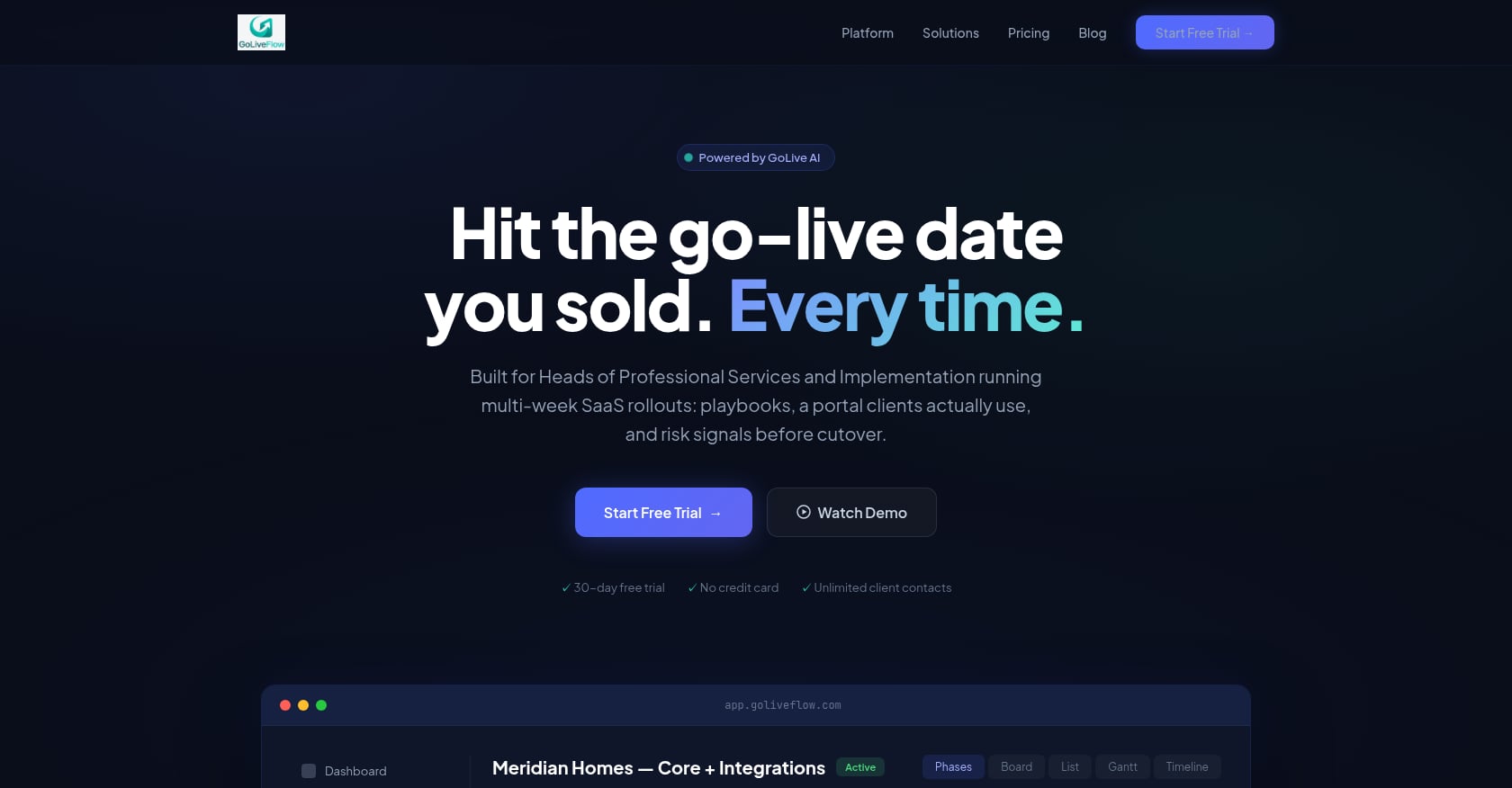
Best for: AI-powered implementation and onboarding management
GoLiveFlow is an AI-powered implementation platform that coordinates customer onboarding from signed deal to go-live. It fills the gap between deal close and first value, the exact phase that generic CS platforms ignore.
Pricing:
- Starter: $19/mo per seat (up to 3 seats, 5 active projects)
- Professional: $49/mo per seat (25 active projects, full interactive portal, e-signatures, automation rules, analytics, API)
- Enterprise: $99/mo per seat (unlimited projects, SSO/SAML, AI Copilot with 50 queries/day, priority support)
- No minimum seats. All plans include unlimited client contacts. 30-day free trial, no credit card required.
Key AI Features:
- AI Copilot provides natural-language Q&A on project risk, drafts status emails, generates meeting briefs, and triages portfolios
- AI risk detection surfaces root causes (overdue dependencies, low login activity, budget burn) and suggests next actions
- Engagement scoring alerts teams when clients disengage after kickoff
- Branded client portal with step-by-step wizard reduces confusion and improves task completion
Trade-offs:
- Salesforce and Outlook integrations are coming soon but not yet generally available
- SOC 2 certification is in progress, not yet complete
- Newer brand with limited third-party reviews
Claimed outcomes: 40% faster time-to-value, 3x better client engagement, 60% fewer overdue tasks, 90% on-time go-lives, and 50% less PM time on status updates.
For teams struggling with clients disappearing after kickoff, GoLiveFlow’s engagement scoring directly addresses that pattern. Learn more about configuring engagement alerts to trigger intervention.
Start a 30-day free trial of GoLiveFlow to test AI risk detection during your next onboarding project.
2. Gainsight
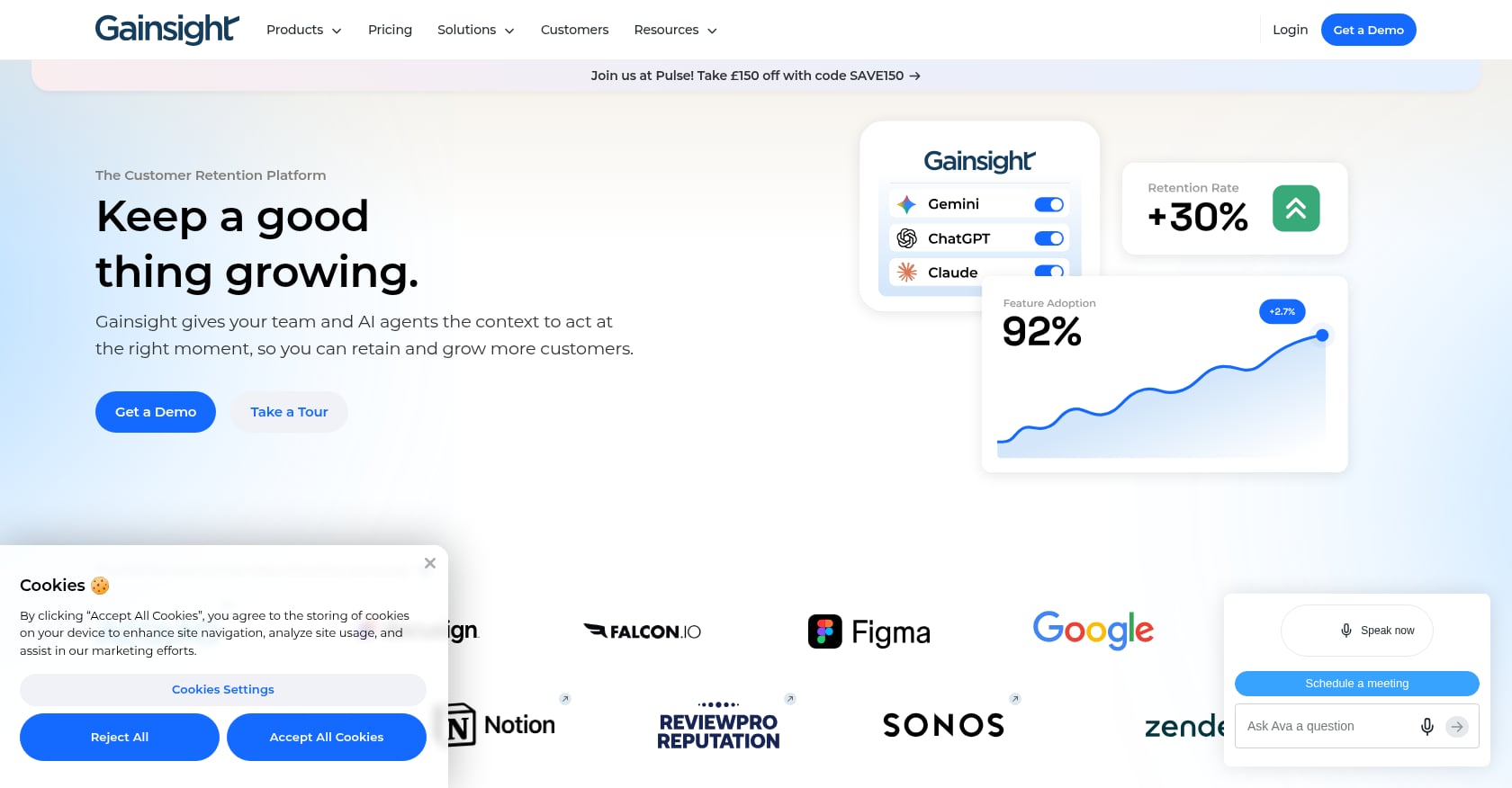
Best for: Enterprise CS operations at scale
Gainsight is the market leader in customer success platforms, optimizing customer relationship management across onboarding, retention, and workflow efficiency. Its AI capabilities span the full post-sale lifecycle.
Pricing:
- Custom, quote-based pricing only
- Third-party sources report Essentials at roughly $150/user/month and Enterprise at roughly $300/user/month
- Annual contracts range from $13,000 to $200,000+
- Implementation costs add $30K to $120K
- No free trial for the CS product (the free trial on their pricing page belongs to Product Experience, a separate product)
Key AI Features:
- Staircase AI reads emails, meetings, and support tickets for sentiment and risk signals
- Atlas AI Agents handle autonomous adoption monitoring, renewal tracking, and account health assessments
- Customer 360 view with AI-powered health scorecards
Trade-offs:
- Significant configuration overhead; G2 reviewers consistently flag complexity
- AI features (Copilot, Insight Agent) bolt onto existing architecture rather than simplifying it
- Pricing lacks transparency, and evaluating the CS product requires a sales conversation
- Autonomy 4/5, Integrations 5/5, Pricing clarity 2/5, Setup difficulty 1/5
User perspective: One Staircase AI reviewer on G2 noted, “I get alerts when my client is not happy so I can jump on top of the issue right away.”
Gainsight ranks #1 for this query partly because of domain authority, but also because it covers AI across the entire CS lifecycle rather than focusing on a single phase.
3. ChurnZero
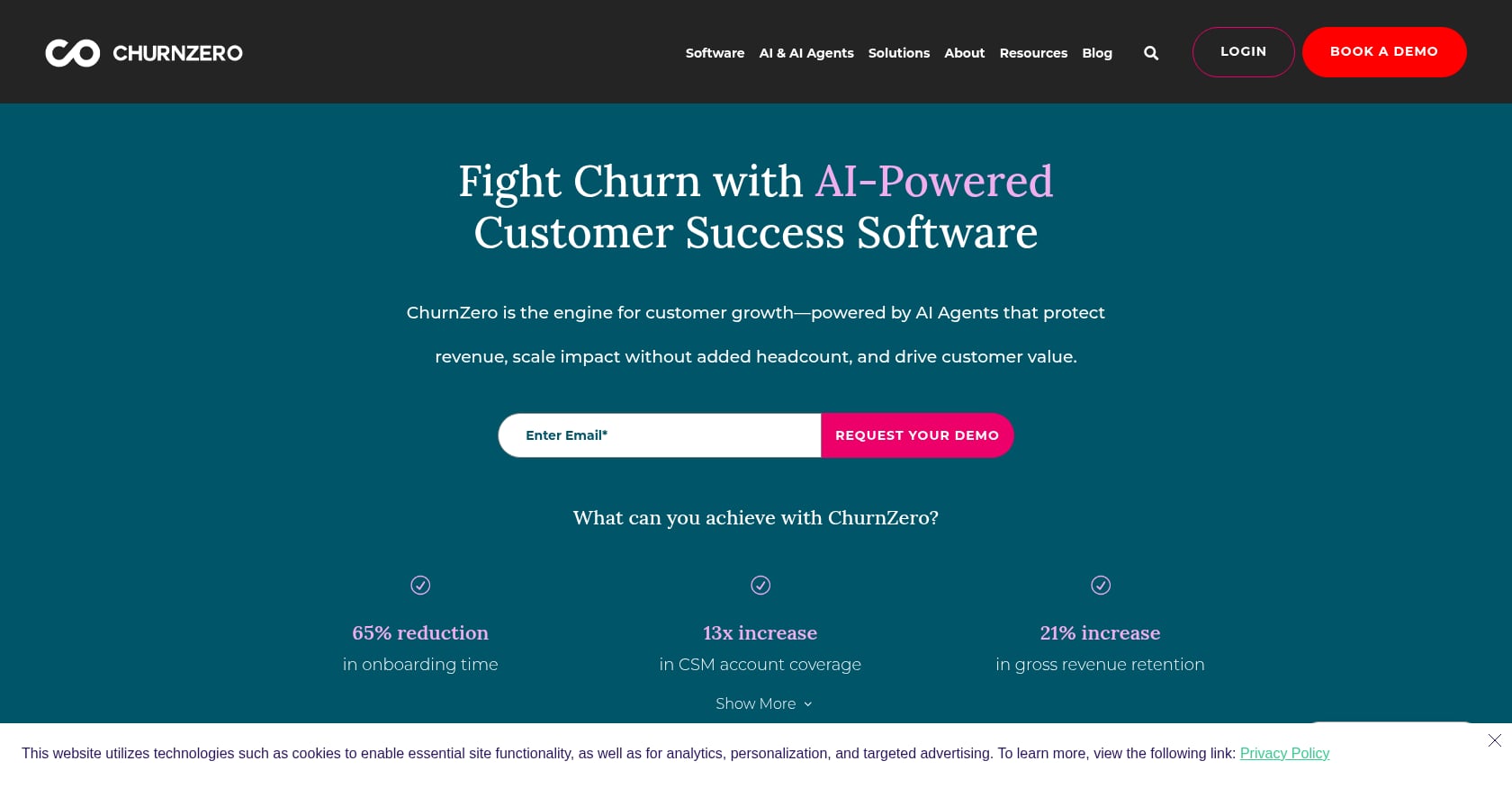
Best for: Mid-market SaaS churn prevention and renewal automation
ChurnZero is an AI-powered customer success platform built specifically for SaaS and subscription businesses focused on reducing churn, improving onboarding, and forecasting renewals.
Pricing:
- Starting at approximately $849/month for the entry plan
- Mid-market deployments (500 customers, 2 CSMs): $25K to $40K/year
- Quote-based, with entry points around $12,000/year climbing to $15,000 to $30,000+ for teams managing 100 to 500 accounts
- No free trial, no free plan
Key AI Features:
- Agentic Essentials: 15+ AI agents built natively into the platform
- Self-serve AI Marketplace for extending agent capabilities
- Automated renewal forecasting and playbook execution
Trade-offs:
- 87 G2 reviewers independently flag steep learning curves
- Reporting rigidity and unintuitive search/navigation are the top two persistent complaints
- Cost scales quickly for growing teams
- No way to trial the product before committing
User perspective: ChurnZero holds a 4.7/5 G2 rating with 1,558+ reviews. The high score reflects strong churn prevention outcomes, but the learning curve warnings are worth taking seriously if your team is lean.
4. Vitally
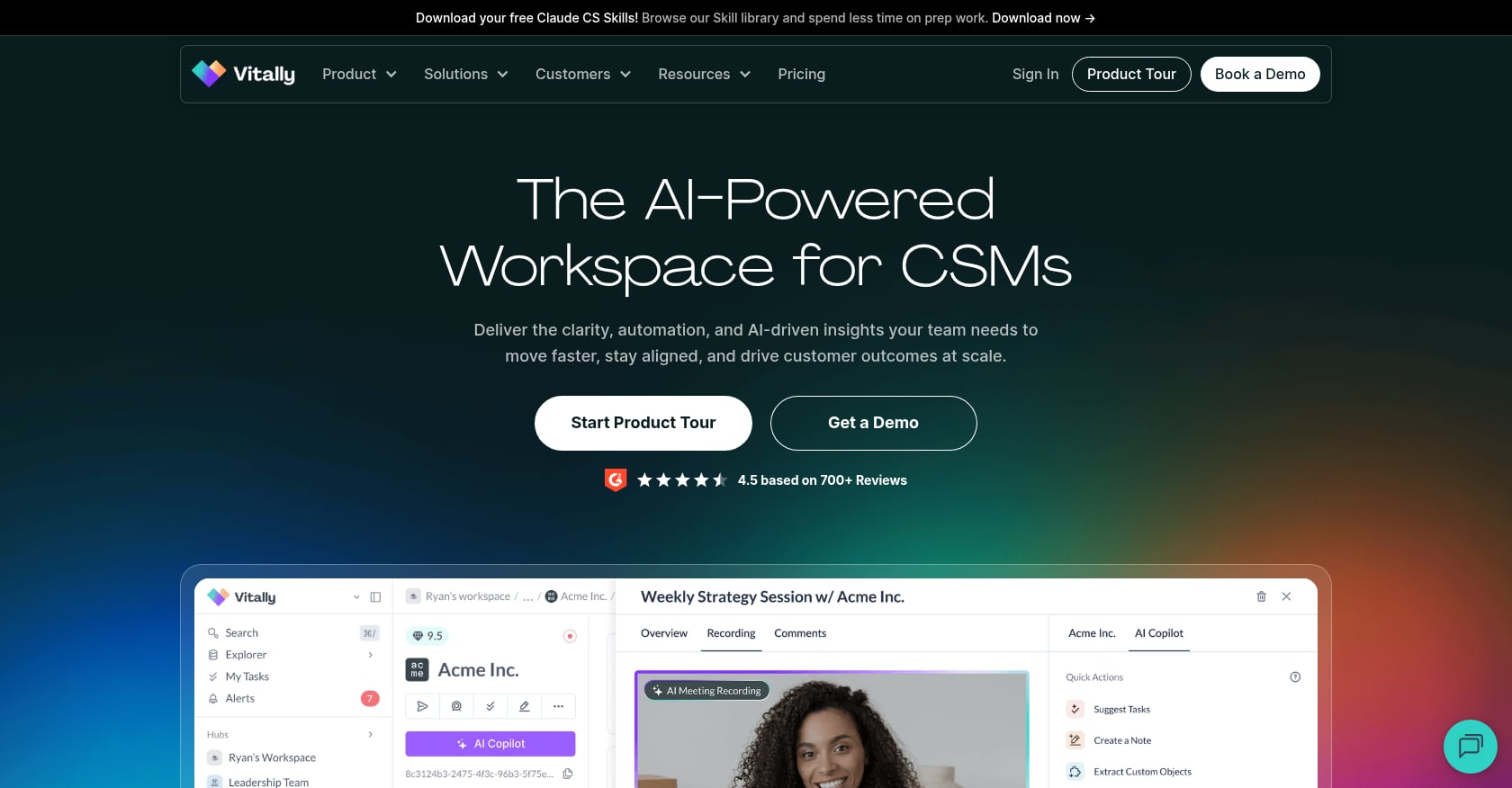
Best for: Fast-growing SaaS teams needing modern UX and quick setup
Vitally combines customer health scoring, workflow automation, and real-time dashboards in a consumer-grade UI that teams actually enjoy using. Its go-live time is notably fast for the category.
Pricing:
- Quote-based across three plans: Tech-Touch, Hybrid-Touch, High-Touch
- Entry deals reported starting around $300/month
- Small deployments (100 to 500 accounts) see annual contract values of $18,000 to $36,000
- AI features are priced as add-ons
Key AI Features:
- AI-powered health scoring and account summaries
- Unlimited automations on every plan (no feature gating)
- Customizable reporting with real-time dashboards
Trade-offs:
- AI add-ons are priced “far above industry standards” according to users, with unclear ROI
- Some users report onboarding specialists being stretched thin
- Quote-based pricing means you can’t evaluate cost without a conversation
User perspective: Vitally’s G2 data puts average go-live at 1.9 months, compared to a category average of 2.6 months. If speed of deployment matters, this is worth noting.
5. Totango
Best for: Teams wanting a free tier to start
Totango (merged with Catalyst in February 2024) is a composable customer success platform with modular templates and a free tier that lets budget-conscious teams start without a purchase order.
Pricing:
- Free tier: up to 100 customer accounts with core health scoring
- Starter: approximately $249/month for up to 500 accounts
- Growth: approximately $1,099/month with unlimited accounts and advanced AI
- Enterprise configurations (2,500 accounts, 3 editor licenses) list at $120,000/year, though buyers report achieving 30 to 39% discounts
Key AI Features:
- Unison AI for intelligent account monitoring
- SuccessBLOCs: modular, pre-built templates for onboarding, renewal, and expansion workflows
- Composable architecture lets teams assemble workflows without heavy configuration
Trade-offs:
- Post-merger brand confusion between Totango and Catalyst is a real concern; the platforms are still being unified
- Enterprise packages add Catalyst Customer Growth Platform and Unison Customer Intelligence engine as separately priced modules
- The free tier is genuinely useful for getting started but limited to 100 accounts
Practitioners on forums report mixed experiences with the merger. Some appreciate the combined feature set, while others describe integration rough edges that haven’t fully smoothed out yet.
6. Planhat
Best for: Flexible data modeling and unlimited users
Planhat positions itself as a customer platform where you define the data model, with CS running on top. Its unlimited-user pricing model makes it attractive for organizations where many people need visibility into customer health.
Pricing:
- Quote-based with no public pricing
- Median annual contract: $41,255 (range: $19,866 to $118,800)
- Pricing is based on customer accounts managed, not per seat
- All plans include unlimited users
Key AI Features:
- 10,000 AI credits on a rolling 30-day basis included with all plans
- AI automation steps, conversation summaries, sentiment analysis, and classification
- Flexible data modeling supports custom health scoring logic
Trade-offs:
- Typically requires a multi-year contract commitment
- Setup effort is high and needs a dedicated internal owner
- No free trial available
- The per-account pricing model can be opaque until you get a quote
At Planhat Open 2025, CS leaders discussed the gap between AI promise and AI delivery. Planhat’s included AI credits represent a different approach: rather than charging for AI as an add-on, they bake it into every plan. Whether 10,000 credits per month is sufficient depends entirely on team size and usage patterns.
7. Custify
Best for: Lean SMB teams wanting simplicity without setup fees
Custify is an AI-powered CS platform that handles the essentials (health scoring, playbooks, lifecycle tracking, sentiment analysis) without the complexity overhead of enterprise platforms.
Pricing:
- Starting at approximately $899/year based on review data
- Median annual contract: $16,752 per Vendr data
- No setup fees
- Quote-based for specific configurations
Key AI Features:
- AI-generated customer summaries
- Churn risk detection based on existing CS processes
- Sentiment analysis across customer interactions
Trade-offs:
- Fewer advanced features compared to larger competitors
- Better fit for smaller businesses with tighter budgets
- Limited AI depth compared to platforms like Gainsight or ChurnZero
Custify’s strength is doing the basics well without requiring a dedicated administrator or months of configuration. For SMB teams running AI in customer success for the first time, that simplicity has genuine value.
8. Dock
Best for: Revenue teams extending deal rooms into onboarding
Dock is an AI revenue enablement platform that provides digital sales rooms, customer onboarding hubs, content management, and learning tools. Its primary value in a CS context is bridging the handoff from sales to post-sale.
Pricing:
- Free plan: $0
- Standard: $350/month for 5 users
- Premium: $1,000/month for 10 users
- Enterprise: custom pricing
Key AI Features:
- AI content generation for deal rooms and onboarding hubs
- Shared workspace that continues from sales into customer onboarding
- Embedded learning and content management tools
Trade-offs:
- Primarily a sales and revenue enablement tool, not a dedicated CS platform
- Lacks implementation-specific features like SLA tracking, engagement scoring, or AI risk detection
- Limited reviews make it harder to assess real-world performance at scale
- If your primary need is post-sale CS operations, this isn’t the right fit
Dock works best as a complement to a dedicated CS or implementation platform rather than a replacement for one. Teams already using Dock for sales may find the onboarding extension convenient, but it won’t replace purpose-built tools for customer onboarding in SaaS.
How to Choose: A Decision Framework
By Company Stage
Startup or early stage: Start with Totango’s free tier to build foundational health scoring, or Custify if you want simplicity without setup fees. For implementation management specifically, GoLiveFlow’s Starter plan at $19/mo per seat keeps costs minimal.
Growth stage (50 to 500 customers): Vitally offers fast deployment with modern UX. GoLiveFlow’s Professional tier covers onboarding automation with full portal and e-signature capabilities. The combination of an implementation tool and a CS platform is increasingly common at this stage.
Enterprise (500+ customers): Gainsight and ChurnZero dominate here, though the price tag reflects it. Planhat’s unlimited-user model makes sense for organizations where many stakeholders need account visibility.
By Primary Need
- Implementation and onboarding: GoLiveFlow
- Churn prediction and prevention: ChurnZero
- Full lifecycle CS at scale: Gainsight
- Budget-friendly starting point: Totango (free tier) or Custify
- Sales-to-CS handoff: Dock
By Pricing Model
Understanding the pricing model matters as much as the sticker price. Per-seat pricing (GoLiveFlow, Gainsight) scales with team size. Per-account pricing (Planhat) scales with customer count. Platform fees (ChurnZero, Vitally) are less predictable without a quote.
A critical note: every major CS platform vendor is now marketing “agentic” health scoring and next-best-action recommendations, but almost none publish list pricing for the AI layer specifically. Budget for AI features as a negotiated add-on, not a line item. For a detailed comparison of onboarding tools vs. project management tools, the differences in scope and pricing are worth understanding before committing.
Implementation Playbook: Getting Started with AI in Customer Success
Start Internal, Then Go External
This might be the most important piece of advice in the entire article. Deploy customer-facing AI too early and you risk damaging trust. Research indicates 75% of organizations believe a lack of AI transparency leads to higher churn rates.
Start with internal efficiency gains: meeting note summarization, email drafting, portfolio triage, status report generation. These are low-risk, high-reward applications where mistakes don’t reach customers. Once your team trusts the outputs, gradually expand to customer-facing workflows.
Pilot One Workflow for 30 Days
Don’t try to AI-enable your entire CS operation at once. Pick one workflow, like onboarding risk detection or renewal forecasting, run it for 30 days, and measure against a baseline. Teams that take this approach report clearer ROI and faster internal buy-in.
Companies implementing AI support thoughtfully are seeing 3.5x to 8x returns on their investment. The key word is “thoughtfully.” The teams seeing AI fatigue are the ones that deployed broadly without measuring.
Fix Data Quality First
Data quality is the number one blocker for AI in customer success. If your CRM data is inconsistent, your health scores will be unreliable no matter how sophisticated the AI. Before purchasing any tool, audit your data hygiene: are customer records complete, are usage events tracking correctly, and are support tickets categorized consistently?
For practical strategies on improving client engagement during B2B implementation, clean data is the foundation everything else builds on.
Build the Bridge Between Implementation and CS
The implementation-to-CS handoff is where value leaks. If your implementation team uses one tool and your CS team uses another, critical context about onboarding quality, client engagement levels, and unresolved issues gets lost in the transition.
The strongest AI customer success strategies connect implementation quality to first-value milestones to retention outcomes. That means either using tools that span both phases or building explicit handoff workflows between your implementation platform and your CS platform.
Explore how GoLiveFlow bridges implementation and customer success with AI risk detection that catches problems before they become churn.
Frequently Asked Questions
What is AI in customer success?
AI in customer success refers to using artificial intelligence, including machine learning, natural language processing, and automation, to help CS teams manage customer relationships more effectively. Applications range from health scoring and churn prediction to automated meeting summaries, risk detection during onboarding, and renewal forecasting.
Where should AI be applied first in customer success?
Most teams get the best early returns from internal efficiency use cases: meeting note summarization, email drafting, and status report automation. These are low-risk and deliver immediate time savings. For strategic impact, onboarding and implementation risk detection offers the highest long-term value because it addresses churn triggers before they compound.
How much do AI customer success tools cost?
Pricing varies dramatically. Entry-level options start as low as $19/mo per seat (GoLiveFlow Starter) or free (Totango’s free tier). Mid-market platforms like ChurnZero start around $849/month. Enterprise platforms like Gainsight range from $13,000 to $200,000+ per year. AI features are increasingly priced as add-ons rather than included in base plans, so ask specifically about AI pricing during evaluation.
Is “agentic AI” in CS platforms real or just marketing?
It’s mostly marketing in 2026. Every major vendor now claims agentic capabilities, but execution varies wildly. Some platforms offer genuinely autonomous agents that monitor accounts and take actions. Others have rebranded existing automation as “agentic.” Ask vendors for specific examples of what their agents do without human input, and request a trial or sandbox to verify.
How many more accounts can a CSM handle with AI?
Teams that have operationalized AI in customer success report handling account loads that would have required 1.3x to 1.5x as many CSMs three years ago. Highly skilled workers using generative AI can improve performance by up to 40%. However, these gains depend on deliberate implementation, not just purchasing a tool.
Can AI replace CSMs?
No. AI automates routine tasks (roughly 30% of a CSM’s workload) and surfaces insights that would otherwise be invisible, but the relationship-building, strategic guidance, and qualitative judgment that drive customer outcomes remain fundamentally human. The better framing is that AI makes each CSM more effective, not that it replaces them.
What’s the biggest risk of using AI in customer success?
Deploying customer-facing AI before it’s ready. Awkward phrasing or incorrect information sent under a CSM’s name damages trust, especially with high-value accounts. Start with internal use cases, validate outputs, and expand to customer-facing applications only after your team is confident in the quality.
How do I measure ROI on AI in customer success?
Start with a baseline measurement of the specific workflow you’re automating: time spent on status updates, number of at-risk accounts caught before renewal, average onboarding duration. After 30 to 90 days of AI-assisted operation, compare against that baseline. Companies implementing AI support well report 3.5x to 8x returns, but your results will depend on the use case and implementation quality.